Contact Us
Newsletter Sign Up
Find us on Facebok   Follow us on Twitter   Watch us on YouTube   Subscribe to our Feed
Donate Now!

News Archive


Exciting Results from Our HopeBuilder Breakfast

Wow! What a morning! HopeBuilder 2010 was a great success. More than 1,000 people gathered this morning at the Oregon Convention Center and heard inspiring stories from families whose lives have been touched by Habitat’s mission.

We were able to raise more than $226,000 in donations and pledged commitments! This will go a long way in the coming months as we get underway on homes for families in north Portland and finish homes in southeast Portland and Gresham.

Every home Habitat builds makes all the difference in the world to a family. Permanent, stable housing means that more homeowners are paying into the local tax base and becoming rooted in our community. It means children will not be constantly changing schools every time the rent goes up, bringing stability into the classroom. It means that families and children will be healthier because they are not living in places with mold and faulty electricity. It means that Habitat is more than houses, it is a springboard for good health and lifelong learning.

Thank you to everyone who attended. You are a part of what makes Habitat more than houses. If you couldn’t make it, you can click this link and read the family stories shared at the event as well as my thoughts on what makes a livable city truly livable. You can also read and post comments about the event on Twitter at #hopebuilder. Please share this information along with ways to give to those who would still like to participate in our HopeBuilder Breakfast and join us in our mission.

Congratulations to everyone!

Steve Messinetti

Executive Director

Habitat for Humanity Portland/Metro East

Annual weeklong ‘Jimmy and Rosalynn Carter Work Project’ kicks off on World Habitat Day in October

ATLANTA (April 13, 2010) — Habitat for Humanity’s 27th annual “Jimmy and Rosalynn Carter Work Project” will kick off a week of building, rehabilitating and repairing homes. Build activities begin on World Habitat Day, Oct. 4, as part of a worldwide effort to highlight the need for stable communities and healthy housing.

“Rosalynn and I are pleased to join Habitat for Humanity volunteers in six communities this year to help raise walls on new homes and improve existing housing,” said President Carter. “More than 75 homeowners will realize new or improved housing conditions as a result of this week.”

The Carters will work with volunteers in Washington, D.C.; Baltimore and Annapolis, Md.; Minneapolis and St. Paul, Minn.; and Birmingham, Ala. In each location, volunteers will participate in a combination of building new houses and improving existing homes.

This year’s Habitat for Humanity Carter Work Project is in conjunction with the United Nation’s World Habitat Day. Annually, on the first Monday of October, people around the world join together to advocate for the need and importance of housing and to exchange ideas. This year, Habitat will highlight the needs of communities in recovery in the United States and will focus on the critical link between health and housing overseas. As part of its awareness-raising emphasis, Habitat for Humanity International is expanding its 2010 World Habitat Day into weeklong events.

“Habitat for Humanity and its partners will increase our efforts to help struggling communities both in the United States and around the world so that even more families have an opportunity to live in decent homes,” said Jonathan Reckford, CEO of Habitat for Humanity International. “We are grateful that the Carters and volunteers are joining us in this important work. Whether we are building new houses, or rehabilitating and repairing existing structures, we want to find the best way to make a significant and positive local impact.”

To achieve this, Habitat for Humanity’s new “Neighborhood Revitalization Initiative” aims to support local Habitat affiliates to serve more families by responding to community needs with an expanded array of products as part of community development that enhances quality of life. Habitat affiliates and their partners will decide on the work carried out locally, but the initiative’s services may include new house construction, rehabilitation of vacant properties (including foreclosed properties), house repairs for existing low-income homeowners, weatherization to make houses more energy-efficient and affordable, and community planning partnerships to ensure more services are available to further stabilize communities.

“Since Habitat’s founding, we have been rehabilitating and repairing homes in our efforts to serve families,” said Reckford. “However, for us to make an even deeper impact on neighborhoods across the country, we want to partner with other groups to improve communities that are facing a number of challenges.”

Along these same lines, Habitat for Humanity’s Jimmy and Rosalynn Carter Work Project for 27 years has been a catalyst for increasing the work being done in local communities and empowering people to bring hope, stability and housing solutions.

President and Mrs. Carter are Habitat for Humanity’s most famous volunteers and give a week of their time each year to help Habitat build, renovate or repair homes and raise awareness about the need for affordable and decent housing. Similar to Habitat’s Neighborhood Revitalization Initiative, the Carters joined Habitat for Humanity in 1984 to help renovate a decaying building in New York City’s Lower East Side. Today, the building is part of a thriving, reinvigorated and dynamic community. Since that first build, the Carters and thousands of volunteers have worked with Habitat for Humanity across the United States and in Mexico, Canada, Hungary, South Africa, South Korea, India, the Philippines, Thailand, Cambodia, China, Laos and Vietnam.

Executive Build a Success! Local CEO’s Roll Up Sleeves on the Construction Site

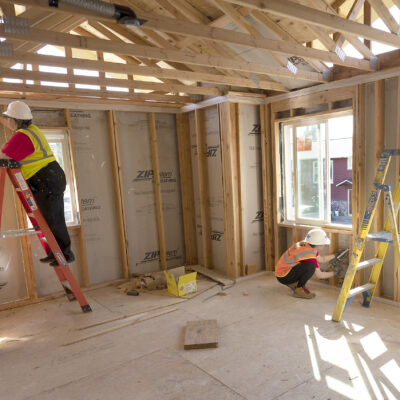
Top Executives of 14 companies joined forces with future homeowners on April 9, for the Spring 2010 Executive Build at Jubilee Commons. Future homeowner Ana Perez-Claveria and her daughter, Emily, (right) led a team installing blocking on the second story. Co-host Craig Wessel, publisher of the Portland Business Journal, cut materials and helped with blocking, while  on the first floor, volunteers finished sheeting interior walls. Co-host and long-time Habitat supporter Bob Walsh (left), president of Walsh Construction Co. , aided these efforts. Outside a group of volunteers raised three-story beams that will support stairwells to the four, two-bedroom, townhome-style condos located above the four, one-bedroom ground floor homes.

After a solid half-day of construction, participants gathered in the community center to share lunch and hear first-hand from current and future Habitat homeowners. Future homeowner Greg Ivory shared how his past has been bumpier than he imagined. He has struggled with substance abuse, health issues and is also a cancer survivor. Being clean for over three years, Greg is working hard to repair the damage in is life. He has started his own business, G I Trucking Co., to provide a stable income for himself and provide a service to his community. Greg found out about Habitat for Humanity from a flyer and figured that it was a great opportunity for him to finally buy a home of his own. “Getting connected with Habitat has given me an opportunity to give back instead of taking all the time,” said Greg. “If you give people the help they need, they are then able to give back.”

Special thanks to the following executives for joining Bob Walsh and Craig Wessel in helping the next eight future homeowners: Jordan Bader of Acme Construction Supply; Gabe Genauer and Greg Capen of of B & G Builders, Inc.; Judith Huck of Classique Floors; Udo Rieder of Erickson Air-Crane; Dawn Holden of Golf Savings Bank; Ed Herinckx of HMH; Julie Leuvrey of Oregon Pacific Investment Development Co.; Steve Malany of P & C Construction; Joel Kaplan of Roberts Kaplan LLP; Anton Oehlert of Union Bank; Jeff Grubb and Tom Taylor of Wells Fargo.

Our Executive Director Goes to DC to Advocate for Habitat

Yesterday, more than 200 Habitat advocates, including our Executive Director Steve Messinetti, held meetings with members of Congress on Capitol Hill, asking them to suppport Habitat. Today, some will meet with Obama administration officials at the White House. You can take action now and help make poverty housing a thing of the past!

Take action now!

You can make a powerful impact today. Elected officials listen to the priorities of the people they represent, so speak up! Ask Congress to support policies that help place families in safe, decent and affordable homes. With your voice, we can truly make poverty housing a thing of the past.

AmeriCorps NCCC Work With Habitat Until April 1

Building for a Better Future

February 26, 2010 (Portland, Ore.)-An AmeriCorps National Civilian Community Corps (NCCC) team is joining forces with Habitat for Humanity Portland/Metro East and its volunteers from now through April 1 to help frame 12 houses for low-income families.

The NCCC members will be working on the framing stages of the building process. Tasks will include site roll-out and clean up of equipment used each day, clean up of site debris, checking site for security at the end of the day and notifying the site supervisor of any possible unsafe work conditions. The team will work with 100-150 volunteers a week, including four full-time AmeriCorps members.

Andrew Holve, an NCCC Corps member, says, “I love being outside doing construction work. I really enjoy going to work and seeing all that I accomplish.

AmeriCorps NCCC is part of AmeriCorps, a network of national service programs created to improve the environment, enhance education, increase public safety, and assist with disaster relief and other unmet human needs. The Pacific Region campus, located in Sacramento, Calif. serves Alaska, California, Hawaii, Idaho, Montana, Nevada, Oregon, Utah, Washington, Wyoming, and the territories of Guam and American Samoa. The Pacific Region campus is one of five campuses in the United States; the others are located in Perry Point, Md.; Vinton, Iowa, Vicksburg, Miss. and Denver, Colo.

AmeriCorps members must complete at least 1,700 hours of service during the 10-month program. In exchange for their service, they receive $5,350 to help pay for college or to pay school loans. AmeriCorps is administered by the Corporation for National and Community Service. For information about applying to an AmeriCorps program, call 1-800-942-2677 (1-800-94-ACORP) or visit the website at www.americorps.gov/nccc.

Habitat Sets Goal of Serving 50,000 Families in Haiti

Habitat for Humanity International has set a goal of serving 50,000 families affected by the tragic Jan. 12 earthquake in Haiti. Habitat’s commitment to Haiti comes with the pledge that it will not distract from commitments elsewhere in the world. The Haiti response will have a specifically dedicated staff for the next three to five years, much as did Habitat’s response for the 2005 hurricane damage on the U.S. Gulf Coast.  Funds used in Haiti will be donations specifically designated for that purpose. Habitat will not divert funds from other needs. Habitat for Humanity International has asked U.S. affiliates to support the Haiti response.  In the spirit of “One Habitat,” Habitat for Humanity Portland/Metro East is joining forces with other U.S. affiliates to help raise the funds necessary to help with the Haiti commitment.

Habitat for Humanity’s CEO, Jonathan Reckford shares these messages:

  • Habitat will serve as many families in Haiti as resources allow. We will do this through a variety of programs-from providing the emergency shelter kits to helping with transitional shelters to building core houses in partnership with the local government and other organizations.
  • Our response will be implemented through strategically located Habitat Resource Centers. Contextualized to local needs, HRCs may focus on such services as producing construction materials (e.g., concrete blocks), offering skills training and loaning out tools or heavy equipment-all in ways that develop and support local livelihoods.
  • Habitat for Humanity rebuilds communities and restores hope. Our disaster recovery efforts include family participation and holistic community development to bring back a sense of stability and cohesion in the families and the communities. Habitat is committed to staying with communities throughout the reconstruction process.
  • Housing reconstruction is one of the most challenging components of any disaster recovery plan. It requires titled land, skilled labor, materials, and infrastructure – most of which are in short supply following a disaster.

Support Habitat for Humanity’s commitment to Haiti by clicking below and choosing “Haiti” as the program designation.

Habitat Haiti Update: Emergency Shelter Kits Arrive

This week the first 500 Habitat for Humanity Emergency Shelter Kits arrived to Haiti. Emergency Shelter Kits are designed to help families make immediate repairs and construct emergency shelter. Materials in the kit include a bucket, a tarpualin, wire, rope, a pry bar, a mason’s chisel and trowel, gloves, nails, a hammer and a saw. The kits will be distributed to families by Habitat employees and partners.

At this time volunteers are not being sent to Haiti. On Monday KATU news spoke with our executive director Steve Messinetti about this topic. Watch the clip.

To learn about Habitat for Humanity International’s commitment to rebuilding Haiti please download the Haiti FAQ.

About the Haiti Earthquake

The 7.0 earthquake and strong aftershocks that struck near Port-au-Prince on Tuesday, January 12 have added yet another dimension to the humanitarian crisis and poverty conditions faced by over 80% of Haitians. According to Reuters, the quake hit at a shallow depth of 6.2 miles, just ten miles from the capital city. A hospital and several schools on the island are reported to have collapsed, according to regional news sources. The local authorities have declared the country in a state of emergency. The number of affected persons is unknown. However, Haiti’s ambassador to the U.S. has called the quake a “catastrophe of major proportions.”

This is a major setback for the poorest country in the Western Hemisphere, with 55% of the population living on less than one U.S. dollar per day. In the last two years, political instability, food shortages, and tropical storms and hurricanes have made it impossible for Haitians to break the cycle of poverty. More than 50,000 homes were damaged or destroyed in last year’s storms, and no estimate is available yet as to the damages to Port-au-Prince and surrounding areas, the heaviest populated area of Haiti. Most Haitian homes are poorly constructed with walls built from poorly made concrete bricks, mud and stones, the roof from scrap wood and metal sheets, and dirt floors, making them unable to withstand a natural disaster of this magnitude.

What You Can Do to Help

You can help by sending in a special tithe donation to Habitat Haiti and bring hope to a country in such great need. Please know all 100% of tithe donations are sent to your global partners. Click here to make an online donation to Habitat for Humanity that is designated for earthquake relief in Haiti.

You can also help raise awareness and funds by inserting banner ads into your blogs or personal websites.

Habitat for Humanity’s Immediate and Long-Term Response

Basic needs such as health care, food, water and shelter are the most urgent following an event like an earthquake to try to mitigate harmful after-effects such as spread of disease and insecurity. Habitat for Humanity’s goal is to help low-income families in need of decent housing because of this disaster with an emergency humanitarian response of shelter kits, clean-up and rehabilitation.

Clean-up and cash-for-work
Habitat for Humanity plans to help in clean-up and rehabilitation efforts by mobilizing people to clear the way for shelter construction and home rehabilitation. The size of response will depend upon the amount of support we are able to mobilize. A clean up “cash for work” program would organize people in communities and provide them with tools (shovels, wheelbarrows, bars, etc, etc). People would clean up debris and salvage those materials that could be recycled in a shelter solution. This involvement in productive activity provides an influx of cash to those affected by the disaster to help them meet basic needs such as food, and also contributes to their mental health by providing them with a positive, proactive opportunity to help with recovery.

Emergency Shelter Kits
Emergency Shelter Kits are a basic package of materials (wall panels of either wood, composite such as reinforced plastic or fibrocement, or other materials; as well as sheets for roofs; nails; rope and a hammer). Although price will be determined by cost of materials, which often rise post-disaster, we estimate that the cost for distributing a kit per family will be US$950 per family.

The kits will be distributed to families by Habitat employees and partners who have been trained by Habitat in disaster response and construction techniques. Habitat for Humanity has been implementing vocational education programs in Haiti for the past three years and has a cadre of certified masons and carpenters ready to assist with shelter construction in Port-au-Prince.

Transitional shelters
In a next phase of response Habitat for Humanity plans to repair damaged homes and also rebuild using a transitional shelter model, whereby the shelter provides an immediate solution to a family but also provides a permanent base structure. The model adheres to international Sphere standards and the basic transitional shelter unit consists of a 17.5m2 home, a 2.5 meter porch, and a separate 4m2 latrine/shower unit. The design includes a concrete floor and structure (beams and partial wall), wall panels which can be converted later to a more permanent material, and a hurricane-resistant roof (metal sheets or micro-concrete) at an estimated price of between $2,000 to $3,000.

As the situation stabilizes, Habitat Haiti will build permanent homes for families who lost so much. Just as before the earthquake, Habitat Haiti will provide a variety of services to families ranging from new homes, progressive building initiatives like “core homes”, renovations and financial literacy.

Habitat for Humanity has been at work in Haiti for 26 years and will use its local expertise and mobilize resources as part of the long-term recovery building efforts.

Click here to make an online donation to Habitat for Humanity that is designated for earthquake relief in Haiti.

Habitat Land Bank Featured in Portland Business Journal

Habitat for Humanity Snaps Up Land

From the Portland Business Journal 1/15/10

http://www.bizjournals.com/portland/stories/2010/01/18/story4.html

By Wendy Culverwell

As prices continue to plummet, Habitat for Humanity and other housing agencies are rushing to buy land for future home sites.

Habitat for Humanity Portland/Metro East has launched a campaign to build a four-year inventory of buildable lots, or about 135 construction sites.

The average price paid for residential land in the Portland area has dropped 44 percent in the past three years, to about $166,000, according to the Regional Multiple Listing Service. The organization also notes a sharp drop in the number of transactions – 432 in 2009 compared to 1,240 in 2005.

That makes it a prime time to buy suitable land for Habitat homes.The organization builds simple homes for low-income families.

The Housing Authority of Clackamas County and other housing organizations, including Portland-based Proud Ground, hope to do the same.

Land-banking, as it’s called, is not a new strategy for the Portland chapter of Habitat for Humanity, one of 33 in the state. Five years ago, it committed to doubling its capacity to build plain, low-cost homes to about 40 per year.

It received applications from 400 families in 2009, a 60 percent increase from the 250 it normally receives.

Soaring real estate prices in the middle of the decade kept Habitat from banking much land, but now that costs are falling, it is actively looking for suitable sites, soliciting financial support from donors and applying for government grants.

“Right now, the dollars raised can go a lot further,” said Steve Messinetti, executive director of the chapter, which serves Multnomah and Clackamas counties.

Habitat pays below-average prices by targeting affordable neighborhoods and working with sellers willing to sell at below-market prices to support its mission.

Habitat has about 50 buildable sites, enough to meet need for the next two years.

In recent months, Habitat has identified a handful of prospects, many of them stalled subdivisions.

Messinetti said land-banking saves money by giving the organization time to recruit volunteer designers and engineers, services it generally has to pay for. By lining up land four years in advance, Habitat could cut its development costs by half.

It costs about $30,000 to prepare a site for construction – money that goes into the price of the home.

Statewide, Habitat for Humanity expects to construct its 1,000th home soon.

Like Habitat, the Housing Authority of Clackamas County is in the market for sites, but Trell Anderson, executive director, said progress has been stymied by sellers who don’t believe real estate prices have fallen.

The Clackamas Housing Authority administers federal Section 8 housing vouchers and manages a portfolio of public and affordable housing. Its 920 units of housing are among the oldest in the state. The agency’s long-term goal is to sell many of its single-family residences.

The housing authority strives to locate its units close to shopping, services and transit. It has a six-year wait for Section 8 vouchers and a three-year wait for housing.

Proud Ground, formerly Community Land Trust, is also interested in land banking, though it also places an emphasis on rehabilitating existing housing.

Jesse Beason, executive director, said lack of credit is the main barrier to banking future sites.

“Everybody wants to take advantage of it, but if banks aren’t lending, nobody can take advantage of it,” he said.

Proud Ground has developed or rehabilitated 116 homes in the Portland area. It sells them to buyers under terms designed to keep the homes affordable when they’re resold.

In an ironic twist, the recession and downward pressure on prices have made home ownership more accessible to buyers who in the past might have needed help from agencies such as Proud Ground.

“Our families are able to seize on the downturn and take advantage of more affordable home prices (on their own),” Beason said.
wculverwell@bizjournals.com | 503-219-3415

Haiti Relief Donations Qualify for Immediate Tax Relief

The IRS has announced a new law stating that eligible donations to Haitian earthquake relief efforts through February 28, 2010 can be deducted on your 2009 taxes. Habitat for Humanity Portland/Metro East is proud to be on the list of qualified charities recognized by the IRS to accept donations.

The following is information provided by the IRS to help you determine if your donation is eligible.

Claiming Haitian Relief Donations on 2009 Taxes – IRS YouTube Video

WASHINGTON (Jan.25, 2010) – People who give to charities providing earthquake relief in Haiti can claim these donations on the tax return they are completing this season, according to the Internal Revenue Service.
Taxpayers who itemize deductions on their 2009 return qualify for this special tax relief provision, enacted Jan. 22. Only cash contributions made to these charities after Jan. 11, 2010, and before March 1, 2010, are eligible. This includes contributions made by text message, check, credit card or debit card.

“Americans have opened their hearts to help those affected by the Haiti earthquake,” said IRS Commissioner Doug Shulman.” This new law provides an immediate tax benefit for the many taxpayers who have made generous donations.”

Taxpayers can benefit from their donations, almost immediately, by filing their 2009 returns early, filing electronically and choosing direct deposit. Refunds take as few as ten days and can be directly deposited into a savings, checking or brokerage account, or used to purchase Series I U.S. savings bonds.

The new law only applies to cash (as opposed to property) contributions. The contributions must be made specifically for the relief of victims in areas affected by the Jan. 12 earthquake in Haiti. Taxpayers have the option of deducting these contributions on either their 2009 or 2010 returns, but not both.

To get a tax benefit, taxpayers must itemize their deductions on Schedule A. Those who claim the standard deduction, including all short-form filers, are not eligible.

Taxpayers should be sure their contributions go to qualified charities. Most organizations eligible to receive tax-deductible donations are listed in a searchable online database available on IRS.gov under Search for Charities. Some organizations, such as churches or governments, may be qualified even though they are not listed on IRS.gov. Donors can find out more about organizations helping Haitian earthquake victims from agencies such as USAID.

The IRS reminds donors that contributions to foreign organizations generally are not deductible. IRS Publication 526, Charitable Contributions, provides information on making contributions to charities.

Federal law requires that taxpayers keep a record of any deductible donations they make. For donations by text message, a telephone bill will meet the recordkeeping requirement if it shows the name of the donee organization, the date of the contribution and the amount of the contribution. For cash contributions made by other means, be sure to keep a bank record, such as a cancelled check, or a receipt from the charity showing the name of the charity and the date and amount of the contribution. Publication 526 has further details on the recordkeeping rules for cash contributions.

This year’s special Haiti relief provision is modeled on a 2005 law that, in the wake of the Dec. 26, 2004, Indian Ocean tsunami, allowed taxpayers to deduct donations they made during January 2005 as if they made the donations in 2004.

For more information about this law or claiming your donations on your taxes, please visit www.irs.gov.

Habitat for Humanity Int’l Responds to Immediate Need in Haiti

Residents pass by collapsed buildings after a major earthquake rocked Port-au-Prince, Haiti, on January 13, 2010. Reuters/Eduardo Munoz, courtesy www.alertnet.org.

The 7.0 earthquake and strong aftershocks that struck near Port-au-Prince on Tuesday, January 12 have added yet another dimension to the humanitarian crisis and poverty conditions faced by over 80% of Haitians. According to Reuters, the quake hit at a shallow depth of 6.2 miles, just ten miles from the capital city. A hospital and several schools on the island are reported to have collapsed, according to regional news sources. The local authorities have declared the country in a state of emergency. The number of affected persons is unknown. However, Haiti’s ambassador to the U.S. has called the quake a “catastrophe of major proportions.”

This is a major setback for the poorest country in the Western Hemisphere, with 55% of the population living on less than one U.S. dollar per day. In the last two years, political instability, food shortages, and tropical storms and hurricanes have made it impossible for Haitians to break the cycle of poverty. More than 50,000 homes were damaged or destroyed in last year’s storms, and no estimate is available yet as to the damages to Port-au-Prince and surrounding areas, the heaviest populated area of Haiti. Most Haitian homes are poorly constructed with walls built from poorly made concrete bricks, mud and stones, the roof from scrap wood and metal sheets, and dirt floors, making them unable to withstand a natural disaster of this magnitude.

What You Can Do to Help

You can help by sending in a special tithe donation to Habitat Haiti and bring hope to a country in such great need. Please know all 100% of tithe donations are sent to your global partners. Click here to make an online donation to Habitat for Humanity that is designated for earthquake relief in Haiti.

You can also help raise awareness and funds by inserting banner ads into your blogs or personal websites.

Habitat for Humanity’s Immediate and Long-Term Response

Basic needs such as health care, food, water and shelter are the most urgent following an event like an earthquake to try to mitigate harmful after-effects such as spread of disease and insecurity. Habitat for Humanity’s goal is to help low-income families in need of decent housing because of this disaster with an emergency humanitarian response of shelter kits, clean-up and rehabilitation.

Clean-up and cash-for-work
Habitat for Humanity plans to help in clean-up and rehabilitation efforts by mobilizing people to clear the way for shelter construction and home rehabilitation. The size of response will depend upon the amount of support we are able to mobilize. A clean up “cash for work” program would organize people in communities and provide them with tools (shovels, wheelbarrows, bars, etc, etc). People would clean up debris and salvage those materials that could be recycled in a shelter solution. This involvement in productive activity provides an influx of cash to those affected by the disaster to help them meet basic needs such as food, and also contributes to their mental health by providing them with a positive, proactive opportunity to help with recovery.

Shelter kits
Shelter kits are a basic package of materials (wall panels of either wood, composite such as reinforced plastic or fibrocement, or other materials; as well as sheets for roofs; nails; rope and a hammer). Although price will be determined by cost of materials, which often rise post-disaster, we estimate that the cost for distributing a kit per family will be US$950 per family.

The kits will be distributed to families by Habitat employees and partners who have been trained by Habitat in disaster response and construction techniques. Habitat for Humanity has been implementing vocational education programs in Haiti for the past three years and has a cadre of certified masons and carpenters ready to assist with shelter construction in Port-au-Prince.

Transitional shelters
In a next phase of response Habitat for Humanity plans to repair damaged homes and also rebuild using a transitional shelter model, whereby the shelter provides an immediate solution to a family but also provides a permanent base structure. The model adheres to international Sphere standards and the basic transitional shelter unit consists of a 17.5m2 home, a 2.5 meter porch, and a separate 4m2 latrine/shower unit. The design includes a concrete floor and structure (beams and partial wall), wall panels which can be converted later to a more permanent material, and a hurricane-resistant roof (metal sheets or micro-concrete) at an estimated price of between $2,000 to $3,000.

As the situation stabilizes, Habitat Haiti will build permanent homes for families who lost so much. Just as before the earthquake, Habitat Haiti will provide a variety of services to families ranging from new homes, progressive building initiatives like “core homes”, renovations and financial literacy.

Habitat for Humanity has been at work in Haiti for 26 years and will use its local expertise and mobilize resources as part of the long-term recovery building efforts.

Click here to make an online donation to Habitat for Humanity that is designated for earthquake relief in Haiti.

Enter your e-mail address to sign up for one or all of our E-Newsletters!

Stay connected! Sign-up below to receive our Habitat for Humanity Portland/Metro East E-Newsletter, Portland Pride Build News, or Women Build News!

For Email Marketing you can trust